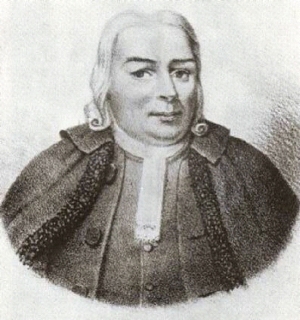
With his often-quoted thought – which we can read in the preface of Magyar Athenas – we can not only characterise Bod Péter's entire life path, work and career, but also understand it as a timely admonition, conveying a message worth taking to heart for posterity.
In his writings he consciously took a stand for the use of the Hungarian language; he was a literary historian of decisive importance, a writer, a Reformed pastor, and a historian of ecclesiastical law and church history.
It is characteristic of a many-sided personality that his scholarly and firmly-held theological principles are connected with his views on church and literary history, with questions of canon law, and with his concept of Hungarian identity.
As a forerunner of the Hungarian Enlightenment, the most significant Transylvanian scholar of the age is one of the most outstanding representatives of progressive Transylvanian culture.
Bod Péter came from an impoverished Székely noble family of the horseman (lófő) rank. Though materially poor, but rich in spirit and intellectual values, he was born as the child of a Székely Hungarian family on 22 February 1712 in the village of Cernatul de Sus in Trei Scaune (Háromszék). He began his elementary schooling in his native village, then at the school in Cernatul de Jos, and later, from 1724, studied at the Reformed College of Aiud (Nagyenyed), where he completed his lower classes in modest circumstances. From his autobiography we learn about his life of want, his fate, his work, his problems and difficulties.(…)
Due to financial troubles he completed his studies with some interruptions. In 1729 he accepted the invitation of the people of Baia Sprie (Felsőbánya) to fill the post of rector. From the earnings gained here he continued his secondary studies at Aiud, where he studied philosophy and theology. He covered the costs of his college life from the annual thirty-forint support of his private pupils, Countess Bethlen Kata, and from the pay of various offices undertaken within the institution. From 1736 he became the college's librarian, and from 1737 assistant teacher of the Hebrew language. From the summer of 1740 the talented young man – as a scholarship holder of the college, to which his benefactors also contributed a certain sum – continued his studies in the Netherlands, at the University of Leiden. There he primarily expanded his theological and historical knowledge, and also studied oriental languages – Hebrew, Aramaic and Arabic – in which he achieved outstanding results. For three years he attended the lectures of renowned professors. In his autobiography he reports with joyful satisfaction about the years in the Netherlands: „I spent three years among studies with the greatest delight of my soul”. On 29 November 1743 he arrives home in Aiud accompanied by a chest of many books, at which point Countess Bethlen Kata, widow of Count Teleki József, receives him into her castle at Hoghiz (Olthévíz) as court chaplain, where he began his service on 29 December. Here he not only performed priestly service but also arranged and catalogued Bethlen Kata's library in the fortress of Făgăraș (Fogaras). He passed the priestly examination on 15 June 1744 at the synod of Bățanii Mari (Nagybacon), and on the 17th he was ordained a priest. From 1746 he is not only court chaplain but also parish priest of Hoghiz. In March 1748 he married Enyedi Mária. From their marriage only one little daughter was born, whom the countess later took in and raised in her manor house, after the child's mother died shortly after the birth. On 2 December 1749, at the invitation of the parish of Ighiu (Magyarigen), they moved to Ighiu. From this moment until his death he held the pastoral office of Ighiu.
On 11 January 1758 he was elected ordinary notary of the church district of Alba Iulia, and on 28–30 June – 1 July 1767, at the synod of Târgu Secuiesc, general notary.
In his autobiography he recounts his life in detail – his marriages, the birth of his children – and reports on the family's tragedies „The sorrow brought upon me by the loss of my children” and on the trials that followed. Furthermore, he writes about his daily duties in the congregation; we can learn how he becomes both the jurist and physician of his beloved people, and we can get to know his circle of friends, his meetings, the printing of his books and its financial aspects as well.(…)
A determining figure of the historiography and literary history of the early Hungarian Enlightenment, a recognised scholarly personality of Transylvania, he departed from among the living on 2 March 1769. His funeral took place in the priests' cemetery of Ighiu on 12 March 1769. In 1912, on the 200th anniversary of his birth, during the festivities organised by the Bethlen Gábor College of Aiud, his ashes were reburied in the churchyard of the Reformed church of Ighiu.(…)
The scholarly pastor spent most of the active period of his life in Ighiu. His earlier teaching post, the order of his Leiden studies and his theological background, as well as his pastoral career, contributed to the preparation of his works on ecclesiastical and pedagogical subjects. Thus, during the years of service spent in Ighiu, he wrote the majority of his theological, church-historical and historical works. His work marked a milestone for Hungarian culture; through his activity and his writings, science advanced beyond the medieval worldview, and not only with his talent and excellent mind, but also with his heart he was a guiding torch of his age, and thus through his life he became a blessing of their nation.
His main work, Magyar Athenas, is the first writers' lexicon in the Hungarian language, containing the biographies of 528 Hungarian writers and scholars of the Carpathian Basin, published in Sibiu (Nagyszeben) in 1766. Furthermore, his work The History of the Holy Bible (Sibiu, 1748) can also be read as the first Hungarian literary-historical monograph, because after the universal history of the manuscripts and editions of the Scriptures it also presents the Hungarian Bible translations. The calendar Szent Heortokrates, that is ... the brief history of the feasts occurring among Christians and of the saints recorded in the ordinary calendars (Sibiu, 1761) summarised the history of the Catholic saints popular in Transylvania. Three years after his guide to church legislation Judiciaria fori ecclesiastici praxis (Sibiu, 1757), he writes the history of the Christian religions from the beginnings to the end of the 18th century, titled The Brief History of God's Militant Holy Church (1760), in whose preface, as the second after Apáczai Csere János, he formulated the timeliness of establishing a Hungarian Learned Society.
In his work titled Szent Hilarius we can read a series of aphoristic observations, interspersed with humour and still relevant today, about life and human character, about relationships, about the workings of society; in fact, in his novel-like book written in catechism form, he criticised the society in which he lived with jovial lightness.
His work consisting of fourteen chapters has remained in manuscript to this day, The History of the Székelys (Siculia Hunno-Dacica), the first detailed description of the Székely Land, before Benkő József and Orbán Balázs, in which he reports in detail on Transylvanian customs, its geographical environment and archaeological finds, mainly in connection with his narrower homeland of Trei Scaune. This work served Benkő József in writing his work „Imago inclytae in Transylvania nationalis Siculucae historico-politica”, published in 1791.
Smirnai Szent Polikárpus (Aiud, 1766), a work usable to this day, contains the biographies of twenty-six Transylvanian Reformed bishops. The Latin–Hungarian, Hungarian–Latin dictionary of Pápai Páriz Ferenc, also published in Sibiu in 1767 under Bod's editorship, supplemented with notes and a German part, was used by students even at the beginning of the 20th century.
In addition to his encyclopaedic and legal activity, his cartographic work must also be mentioned, for he drew maps that did not so much strive for scale and geometric precision, but rather were made with a pedagogical purpose, from which one could read religious maps, history, even the migration of the Hungarians from their ancestral homeland. The maps preserved in the library of the Reformed College of Aiud are the first attempts of Hungarian historical geography.
He learned and studied the Romanian language, and was even interested in the creations of Romanian ecclesiastical literature. In his history written about the Romanians, Brevis Valachorum Incolentium Historia, we can recognise a church history of the Transylvanian Romanians written in the spirit of the first descriptive-statistical school of the state. One of his most monumental works – remaining in Latin to this day – is Historia Hungarorum ecclesiastica.
With his unshakeable capacity for work, his great erudition, his constant readiness to work, and his captivating manner of presentation, he won the esteem of the theologians and the scholarly companions of his circle. In fact, Bod Péter, as a church historian, raised Transylvanian scholarship to the level of European historiography. The works he left behind place him among the greatest historiographers of 18th-century Transylvania.
It was not an easy task that he undertook and that he fulfilled to the measure of his strength. He not only pointed to the right path, but set an example of the right conduct: he expressed ideas and principles as a vibrant reality.(…)
Bod Péter's life's work has a serious message for today's Hungarians as well: the love of the mother tongue, which urges its conscious cultivation; the love of the native land, which obliges us to endure; the bearing of love, gratitude, attachment and fidelity towards one another; the admonition to esteem our fellow human beings; while the example of faith, of continuous learning, and of passing on acquired knowledge strengthens us. His name is surrounded by light, honour and blessing; his entire life, his work as a teacher and scholar, were pervaded by the love of the mother tongue, the native land and his nation, and by the protection and service of these. It is precisely for this reason that since 1990 he has rightly become the namesake of Bod Péter Pedagogical High School in Târgu Secuiesc. His name encourages us, uplifts us, and his legacy obliges us all. We are his disciples, and precisely for this reason it is our task to cultivate further the reverence surrounding his name, to do what he too strove for in his writings; and, in his own words, „To keep good memories of good people!” is our duty. May his wisdom and knowledge always be a burning torch for us, and may his capacity for work be exemplary in the daily work of instruction and education. Bearing in mind the words of Orbán Balázs „Sacred, therefore, is his memory before every Hungarian; great is he, so great as our literary history can show but few, a star of light on the clouded sky of our nation.” may his memory live among us forever.
Kis Emese
References:
dr. Gudor Botond: Bod Péter, Erdély és Magyarigen tudós lelkipásztora In. Erdélyi Református Naptár 2012.
dr. Gudor Botond: Kartográfia történelem és eredetkutatás Bod Péter (1712-1769) térképében. In Orpheus Noster 2010. II. évf. 1 szám.
Orbán Balázs: A Székelyföld leírása. Babits-Magyar Amerikai Kiadó R.T., Szekszárd, 1991.