2026. 03. 13. · Facebook · 3 min read
We add to our illustrated report the article by Iochom István from the Háromszék daily:
Students and teachers of the two educational institutions, as well as secular and ecclesiastical leaders of the commune, paid their respects at the war heroes' monument in Kászonújfalu before the memory of the heroes of the 1848/49 Hungarian Revolution and War of Independence, where – as in previous years – this year the artillerymen from Tápióbicske stood guard of honour. At the ceremony, Constantinescu Herman, director of the Apor Péter Vocational High School, presented a glass plaque to András Ignác, director of the Dr. Lukács Mihály Primary School in Kászonaltíz, engraved with the following thoughts: "We strengthen our partner school relationship, I express my gratitude for the cooperation and we commemorate the heroes of the '48/'49 War of Independence."
After the joint commemoration, the vocational high school students proceeded to Nyergestető, where the Bod Péter Pedagogical High School students evoked, at the monument inaugurated on 8 August 1897, the events of 177 years ago, the heroic resistance of Major János Tuzson and his handful of troops against the overwhelming imperial and tsarist forces. This year too, the delegation of the partner school, the Kölcsey Ferenc Reformed Practice Primary School from Debrecen, was present. The ceremony was opened by the Pedagogical High School's choir with the song "Comrade, are you still alive?", followed by ninth-grade student Pătrânjel Viktória reciting Mihály Vörösmarty's poem "Szózat" (Appeal), and tenth-grade student Simon Brigitta performing the song "In the Year 1848". Following this, the school's ninth-grade students, with the help of poets Garay János, Juhász Gyula and our historians, evoked those events of the 1848-1849 War of Independence, whose climax was the Battle of Nyergestető. Gyula Illyés's poem "Do Not Forget the Ground" was recited by tenth-grade student Géza Timea, and graduating student Deme Katinka sang the song "This Is Our Home...".
Students of the Kölcsey Ferenc Reformed Practice Primary School from Debrecen paid their respects to the memory of the heroic defenders of Nyergestető through their festive programme (coordinating teacher Bencze Gábor), followed by tenth-grade student Zsigmond Nóra, second place winner of the "Zúg Március" speech competition, delivering her oration. The Pedagogical High School's festive programme concluded with the choir singing "Kossuth Lajos Set Out from Debrecen" (coordinating teachers: Fejér Piroska, Hungarian teacher, and Gligor Zoltán, music teacher). Wreaths were laid by: Gál Zsuzsanna, principal of the Bod Péter Pedagogical High School; Kovácsné Jendrek Anikó and Bencze Gábor, teachers from the Kölcsey Ferenc Reformed Practice Primary School in Debrecen; and Szilveszter Szabolcs, deputy mayor of Sfântu Gheorghe.
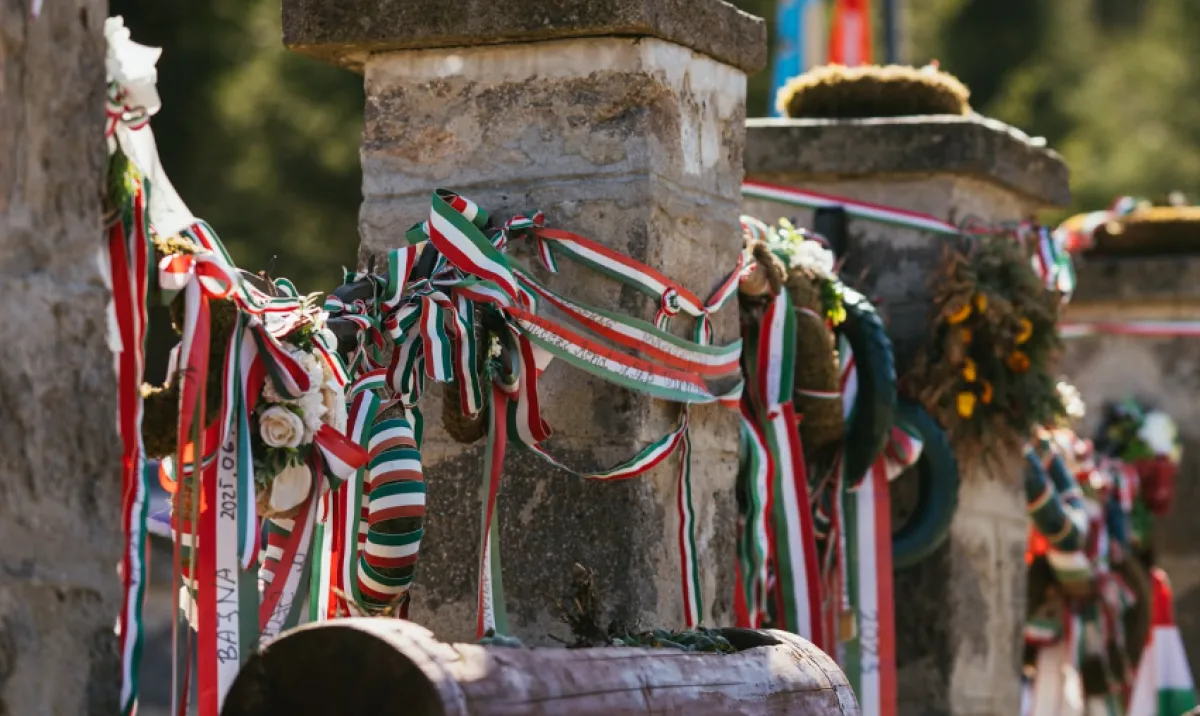
After the Hungarian and Székely anthems, delegates from the two Sfântu Gheorghe high schools proceeded to the wooden memorial poles at the mass grave site, where students of the Apor Péter Vocational High School performed a dramatised historical commemorative programme, evoking the figures of Áron Gábor, József Bem and János Tuzson, their heroic resistance, bowing before the memory of the three heroes. Tenth-grade student Váradi Bernadett delivered a speech. "Proclaiming the idea of freedom, we stand here today; freedom is our weapon when we face the contradictions of this imperfect world, the destruction that takes place in the name of peace and equality! Just as the young men of March knew exactly what would bring them true freedom, so must we clearly formulate our expectations and demands towards the authorities. The future will be what we shape it to be! That is why I call upon you today not to be a crowd, but a community: a Transylvanian, Hungarian and European community!" – said the young orator, among other things, followed by songs and poem excerpts appropriate to the occasion, from Dsida Jenő's poem Psalmus hungaricus (coordinating teacher Dezső Edit).
Subsequently, teacher and local historian András Ignác, director of the Dr. Lukács Mihály Primary School in Kászonaltíz, addressed the audience and recalled one of the last victorious battles of the Hungarian War of Independence, the Battle of Nyergestető, where Major Tuzson with his three hundred men stopped the imperial and tsarist army estimated at three to four thousand (the Battle of Nyergestető is therefore called one of the most heroic battles of the Hungarian War of Independence, also referred to as the Székely Thermopylae – ed. note). He also clarified a question still disputed today concerning the Battle of Nyergestető. After Orbán Balázs, several others – including Sándor Kányádi – recorded the erroneous fact that betrayal had occurred. The local historian studied many ecclesiastical archival sources from the time, and along with several historians, their position is: there is no concrete evidence that betrayal occurred. Knowing the terrain, it is impossible to lead twelve thousand soldiers along a mountain path.
Part of the truth – added the local historian – is that the main road to Kászon at that time did not lead towards Csík in its current location, but through Paphegye, and somewhere at Csekefalva it arrived in Szentmárton. Tuzson considered his soldiers' lives most important when, seeing the danger of encirclement, he decided to retreat. He lost only eight men, four from Upper-Háromszék and four from Kászon, and succeeded in stopping the vastly outnumbering enemy. Under continuous bombardment, he withdrew with his troops through Mitač and united with Sándor Gál's army. András Ignác emphasised: the Battle of Nyergestető did not go down in history as a lost battle. The Székely troops successfully held back the enemy and prevented an immediate breakthrough. At the end of his speech, the director addressed the young people. He encouraged them to learn from the example of the heroes of the 1848–49 War of Independence: with perseverance, courage and unity, life's greatest challenges can be overcome.
Afterwards, the Székely anthem was sung, and the directors of the two Sfântu Gheorghe high schools laid wreaths at the memorial poles they had erected.